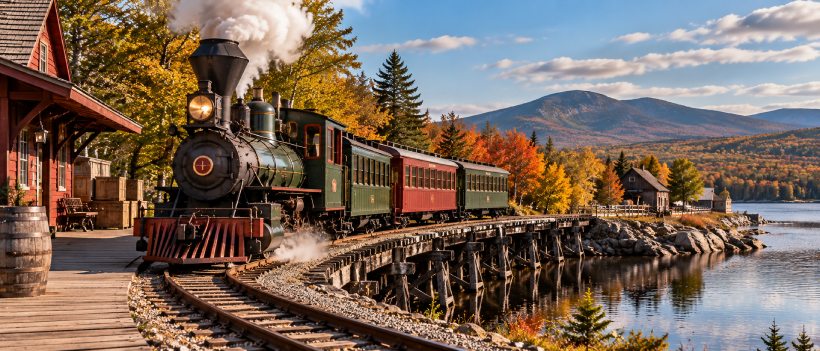
Tracks set closer together than the standard four feet, eight and a half inches – that’s the simple definition of narrow gauge. Maine took that idea and ran with it, building one of the most distinctive two-foot-gauge networks in the country. Compact, clever, and surprisingly extensive, these little railroads threaded through remote forests and farming towns that standard lines never reached. This article covers why they were built, how they operated, why nearly all of them vanished, and where you can still find a piece of that history today.
Why Maine Built Its Two-Foot Railroads
Rural Maine in the 1870s and 1880s was full of small towns, sawmills, granite quarries, and farms that needed rail connections but couldn’t afford standard-gauge construction. Narrow gauge offered a cheaper path in.
The Economic Case
Building a standard-gauge railroad cost far more than most Maine communities could raise. Narrow-gauge lines required less grading, lighter rails, and smaller bridges. Per mile, the savings were significant enough to make otherwise impossible routes financially viable.
The Geography Problem
Maine’s terrain – rocky hills, dense forests, and tight river valleys – made wide curves difficult. Two-foot gauge trains could navigate much sharper bends, opening up territory that standard lines simply couldn’t reach.
The Two-Foot Choice
Most American narrow-gauge railroads used three-foot gauge. Maine went narrower still, adopting two-foot gauge on several lines. That rare choice made the state genuinely distinctive in American railroad history.
Growth, Daily Service, and Eventual Decline
By the 1870s, Maine’s narrow-gauge lines were threading through communities that standard railroads had bypassed entirely. Each line had its own character and cargo.
Peak Years and What the Lines Carried
The Sandy River Railroad opened in 1879, hauling passengers, farm goods, and mail across Franklin County. The Bridgton and Saco River served western Maine’s timber trade. The Monson Railroad carried slate from local quarries. The Kennebec Central and the Wiscasset, Waterville and Farmington connected small towns to larger markets, moving lumber, livestock, and everyday freight.
Why the Lines Disappeared
Automobiles changed everything after 1910. Trucks could reach farms directly. State road-building programs made horse carts and then motor vehicles practical alternatives. Passenger numbers dropped sharply, freight revenue followed, and one by one the narrow-gauge lines closed between the 1920s and 1940s.
Where the Story Still Lives On in Maine
Preservation has kept Maine’s two-foot railroad tradition tangible rather than just textbook history. Two institutions in particular give visitors a direct connection to what once ran through the state’s fields and mill towns.
Maine Narrow Gauge Railroad Co. and Museum – Portland
Based on Portland’s waterfront, this Maine Narrow Gauge Railroad Co. and Museum holds restored locomotives, original passenger cars, and a working stretch of two-foot track. Visitors can ride a short loop and explore exhibits covering the Bridgton and Sandy River lines. It’s a compact but genuinely rewarding stop.
Wiscasset, Waterville and Farmington Railway Museum – Alna
Volunteers here have spent decades reconstructing track and restoring equipment from the original WW&F line. Seasonal train rides operate on rebuilt right-of-way, with a growing collection of authentic rolling stock. There’s no commercial polish – just real restoration work you can watch and ride.
Maine’s Two-Foot Legacy Still Runs Deep
Built out of economic necessity rather than ambition, Maine’s two-foot-gauge railroads served farms, mills, and coastal communities that standard lines simply couldn’t reach affordably. They rose quickly in the 1870s and 1880s, carried passengers and freight for decades, then faded as automobiles and paved roads made them redundant. Most tracks were pulled up by the mid-20th century. What survived, though, is genuinely worth seeing. The Maine Narrow Gauge Railroad Museum in Portland and the Wiscasset, Waterville and Farmington Railway preserve equipment, stories, and short stretches of working track. There’s no denying these little railroads punched above their weight and visiting one today is the most direct way to understand why they mattered.