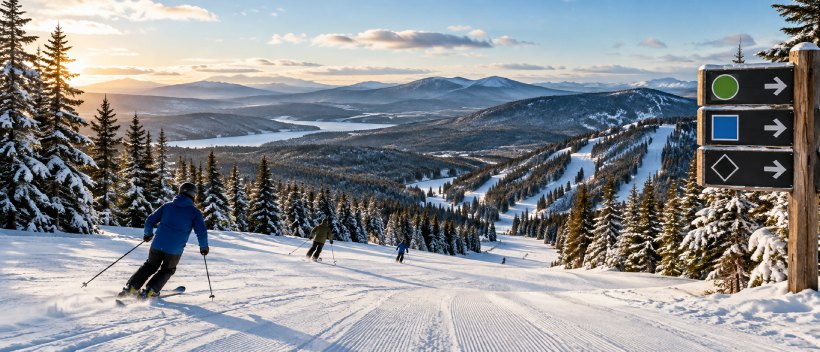
Those little colored symbols on the trail map look straightforward enough. A circle, a square, a diamond – how complicated could it be? For a lot of first-time and casual skiers, though, the ratings end up raising more questions than they answer, especially when a blue run at one resort feels nothing like a blue run somewhere else.
The good news is that the system is genuinely simple once you know what each symbol actually measures and where the gaps in consistency tend to show up. This article walks through the standard ratings, explains why the same label can mean very different things depending on the mountain, and helps you match terrain to your real ability – not just your optimistic one.
What Ski Trail Ratings Actually Mean
Each symbol on a trail map is a quick promise about what’s waiting for you on the mountain. North American resorts use five main markers -green circle, blue square, black diamond, double black diamond, and terrain park. Here’s what each one signals.
Green Circle – Easiest
Wide, gently pitched, and usually well-groomed. Green runs are designed for beginners and slow-paced learners. Expect minimal obstacles and forgiving terrain.
Blue Square – Intermediate
Steeper pitch, narrower width, and occasional moguls. Blues reward skiers who’ve mastered stopping and turning confidently.
Black Diamond – Advanced
Challenging pitch, variable snow, and limited grooming. These runs demand real control.
Double Black Diamond – Expert Only
Extreme steepness, exposure, and obstacles. No grooming, no guarantees.
Terrain Parks
Jumps, rails, and features for freestyle skiers. Ratings here reflect feature size, not slope pitch.
Resorts weigh pitch, width, grooming, and obstacles when assigning ratings – but only relative to that specific mountain, not a universal standard.
Why the Same Rating Can Feel Different at Every Resort
Ratings don’t exist in a vacuum. A blue square at a beginner-friendly resort in the Midwest and a blue square at a steep Vermont mountain are technically the same symbol, but they can feel like completely different runs. That gap comes down to how each resort calibrates its ratings against its own terrain.
Every Mountain Grades on Its Own Curve
A resort dominated by expert terrain tends to rate its easier runs more generously. What’s labeled blue might be a genuine black diamond elsewhere.
Conditions Change Everything
Fresh powder, icy grooming, high elevation, and afternoon sun all shift how a run actually skis. The rating describes the trail’s design, not the day’s conditions.
How to Choose the Right Run With Confidence
Choosing a suitable ski run requires more than understanding trail ratings. Snow conditions, visibility, and terrain can make familiar slopes more challenging. Before heading downhill, take a few minutes to assess your options.
- Check the trail map: Review difficulty ratings, grooming information, and closures before boarding the lift.
- Ask ski patrol: Find out whether slopes are icy, freshly groomed, or covered in moguls.
- Know your limits: Choose runs where you can comfortably control your speed and turns.
- Watch the terrain: Look for narrow sections, steep drops, and ungroomed areas.
Starting with an easier run helps build confidence and reduces unnecessary risks.
The Best Trail Is the One You Can Enjoy
Ratings give you a starting point, not a guarantee. A blue square at a large Colorado resort can feel nothing like a blue square at a small Midwestern hill – the terrain, grooming standards, and overall difficulty vary more than most first-timers expect. Local conditions shift things further. Fresh snow softens a run; ice makes any rating feel a grade harder. Use the symbols as honest guidance, not a challenge to beat. Choose terrain where you can actually ski with control, build confidence, and have fun. The mountain will still be there when you’re ready to move up.